Is the Veil Thinner in October? Where did the Belief Came From?
Is the veil thinner in October?
A belief built in layers
Every layer served a purpose
Every October, the same question finds me. Sometimes it comes from a client at the end of a session. Sometimes it comes from someone who just found out what I do. “Is the veil thinner right now?”
If nobody asks, I read it anyway. It’s on every feed, every store shelf, every seasonal post in my notifications. It’s everywhere this time of year, and it’s overhyped.
I don’t usually offer my opinion unless someone asks for it. People love this season, and I’m not interested in popping anyone’s bubble.
Still with me? Then you want to know what I think, and curious is my favorite kind of reader.
Where I stand on it
Some people love the spooky, eerie stuff, and that’s okay. Some people love the performance of the holiday, and again, that’s perfectly fine. I won’t hype or tear down what anyone else enjoys or believes, either way. I stay in my lane.
To me, though, it’s deeper. This is my faith and my belief, and it doesn’t fade in or out according to a date on a calendar. It’s situational, and it’s personal.
So is the veil thinner in October? Not in my work. A reading on Halloween night feels the same to me as one in the middle of March. The connection shows up when it shows up, and the month has nothing to do with it.
What October does change is how many people are paying attention. It works a lot like buying a new car. Once you drive a red truck off the lot, you start seeing red trucks everywhere. There weren’t more of them on the road the day before. Your brain just started flagging them, because now they matter to you.
So when everything around you says the dead are close right now, you notice more. The dream you’d normally shrug off gets a second look. So does the song on the radio at the exact right moment. Some of that was there all along. The season just gives people a reason to look up from their day and see it.
What does shift for me
What does move me around is the moon.
I’m more sensitive or distracted during full moons and eclipses than I am in any single month. My recall gets scattered, and details come in out of order. My sleep goes sideways, too. I can usually feel a full moon coming several days before it’s here, and eclipse seasons start working on me even earlier. That’s a pattern I can track, season after season. I wrote about what that looks like in session, and what the sleep research says, in my post on the blood moon and lunar eclipse.
The month on its own? Same as any other.
Where the thin veil idea began
If it isn’t the month doing it, then why does everyone say the veil is thinner in October? The answer is a stack of layers, added by different people over a long stretch of time.
It starts with a festival called Samhain, which you say like “SOW-in.” It fell around November 1 in Ireland, and it marked the end of the harvest and the start of winter. Cattle came down from the summer pastures. Then families had to decide which animals they could feed through the cold and which ones they couldn’t. Days were getting shorter fast. Death and darkness weren’t abstract ideas that time of year. They were in the barn and right outside the window.
People all over the world have treated in-between times as a little unsettled. Dusk. A doorway. The night one season hands off to the next. Samhain sat right on that kind of line, so it was an easy place to believe a door might open.
The oldest written stories about Samhain come from Ireland. Monks wrote them down, long after Ireland had become Christian. In those stories, the fairy mounds stand open on Samhain night, and beings from the Otherworld come and go. In one tale, a warrior named Nera follows a fairy host through one of those openings and comes back with a warning about what’s coming. You can read a good overview of those tales on Samhain’s history.
Still, those stories are mostly about the old gods and the fairy folk. Your grandmother coming home to visit barely shows up in them.
Then the church, the Victorians, and a borrowed phrase
By around the year 800, churches in Ireland were already honoring all the saints on November 1. By the 11th century, November 2 had become All Souls’ Day, a day set aside to pray for the dead. Candles, church bells, and children going door to door for soul cakes in exchange for prayers all grew up around those days. So a good share of what we think of as remembering the dead in early November came through the church.
Then, in the late 1800s, a Scottish anthropologist named James Frazer pulled it all into one story. Samhain was an ancient pagan festival of the dead, he said, and the church laid its own holidays on top of it. That version stuck, and it’s the one most people repeat today. Later historians, Ronald Hutton among them, pushed back and said the medieval records don’t support it. They’re still arguing about it.
And the phrase itself? Nobody has found “the veil between the worlds” in anything written before the Victorian era. It came into use through Spiritualism, the 1800s craze for séances and talking to the dead. Modern pagan writers picked it up in the 1900s, and some of them are the first to say so. John Beckett, a pagan writer himself, lays out how new the phrase really is.
Other cultures set aside their own time for the dead, too, and most of them didn’t pick fall. China’s Hungry Ghost Festival and Japan’s Obon both land in the heat of summer. Mexico’s Día de los Muertos does fall on November 1 and 2, but that’s because older traditions there blended with the Catholic calendar after the Spanish arrived. Each culture chose its own date, even though the need underneath it is the same.
A family recipe
None of that history makes the belief less meaningful to me. There’s a lot of knowledge that comes from our ancestors, their beliefs and their rituals. It served a purpose, whoever that person may have been. I try to show respect to all of it, whether it falls into my practice or not.
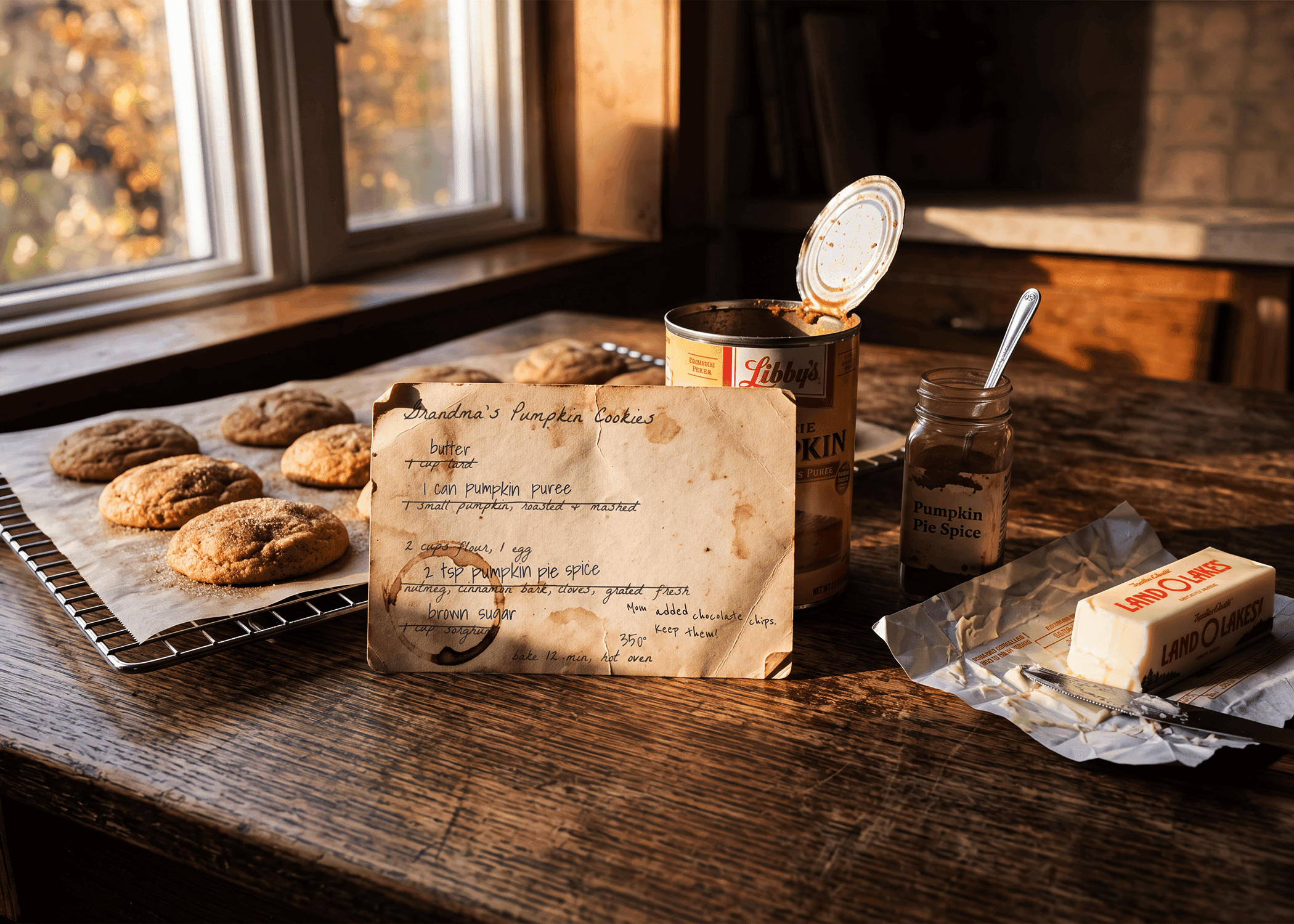
I look at it like a family recipe. Your great-grandmother made it one way. Somebody swapped the lard for butter. Somebody else added a spice they picked up from a neighbor down the road. As it ages and ingredients get easier to find, we add or substitute. We adapt and we learn. But we still respect the original for what it was, as a part of the foundation.
That’s what happened here. Irish harvest customs, the old stories, church holidays, Victorian writers, and a borrowed phrase all went into the pot. What came out is the idea you read everywhere every fall, that the veil is thinner in October. It all plays into the process of our human and spiritual evolution, folklore included.
I use this time of year to pay homage to my ancestors who came before me. I do it the rest of the year, too.
If fall is when you finally feel free to talk about the people you’ve lost, I wrote about what that can look like in Mediumship for Grief.
And if you want to talk about someone you’ve lost, that conversation doesn’t have to wait for October. I’m here for it in March, too.
Not in my work. A reading in late October feels the same to me as one in spring. What changes this time of year is attention, because when the whole culture is talking about the dead, people notice things they’d normally brush off.
It started with Samhain, an Irish festival around November 1 that marked the end of the harvest, and old stories about fairy mounds opening that night. Church holidays for the dead, a Victorian anthropologist, and 1800s Spiritualism added the rest, including the phrase itself.
Both traditions are in it. All Saints’ Day on November 1 and All Souls’ Day on November 2 shaped a lot of how we remember the dead in early November. The name Halloween itself comes from All Hallows’ Eve, the night before All Saints’ Day.
Yes. In my work, connection depends on the person and the situation, not the date on the calendar. You don’t have to wait for October to book a mediumship session.
Free Quiz
Where Do You Fall on the Psychic Spectrum?
Find Your Intuitive Type
24 questions. No right answers. Just honest ones.
Take the Quiz